
Middlemore Hospital (S.M.B.), Auckland, New Zealand; Department of Gynecological Oncology (L.J.E., K.L.F., R.W.J.), Auckland City Hospital, Auckland, New Zealand.
The authors declare no conflict of interest.
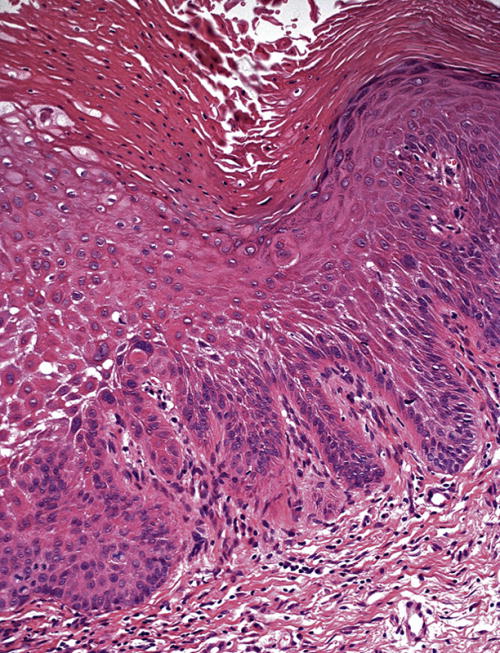
- Abstract. Squamous cell carcinoma of the vulva (SCCV) develops through either human papillomavirus (HPV)-dependent or HPV-independent pathways. Approximately 60% of SCCV arise independently of HPV, commonly in a background of an inflammatory dermatosis, particularly lichen sclerosus. The likely direct precursor to most of these lesions is vulvar intraepithelial neoplasia (VIN), differentiated type (dVIN), although the evidence is largely circumstantial. There are few reports of progression to carcinoma, and the natural history of this pathway is not well understood. Nevertheless, dVIN is widely regarded as a potentially aggressive lesion. We identified dVIN adjacent to SCCV in 97 of 212 women (45.8%). Twenty-four of the 97 women (24.7%) had biopsies performed at least 6 mo before presentation with SCCV; slides for 47 biopsies from 21 women were available for review. dVIN was identified in 18 biopsies from 8 women (38.1%), which in 14 biopsies had been previously unrecognized. The subsequent cancer developed in the same region as the previous biopsy showing dVIN in 6 of the 8 women. The median interval between biopsy and invasive cancer was 43.5 mo (range, 8–102 mo). dVIN-associated SCCV was strongly associated with both lichen sclerosus, and HPV-negative status compared with usual type VIN (relative risk=38.35 (9.755–150.8) and 0.06485 (0.02764–0.1522), respectively). This study adds to the evidence linking dVIN with SCCV, and indicates that both clinical and histologic underrecognition contribute to the apparent rarity of dVIN as a solitary diagnosis. The morphologic spectrum of dVIN is likely to be wider than commonly appreciated; however, histologically defining the lower threshold is difficult and controversial.
- Artículo completo en:
International Journal of Gynecological Pathology
Issue: Volume 35(6), November 2016, p 574–584
Copyright: ©2016International Society of Gynecological Pathologists
Publication Type: [PATHOLOGY OF THE LOWER GENITAL TRACT: ORIGINAL ARTICLES]
DOI: 10.1097/PGP.0000000000000280
ISSN: 0277-1691
Accession: 00004347-201611000-00012
Keywords: Squamous cell carcinoma of the vulva, Vulvar intraepithelial neoplasia, Differentiated type, Natural history, Progression to carcinoma, Diagnostic challenges
 Dr Enrique Vicente Greco - Médico